Explain Equivalence Point and End Point
Endpoint also called indication point should be as near as possibly be at equivalence point it is indicated by sudden change of pH or the color of an appropriate. Endpoint Sometimes equivalence point can be taken as the endpoint since they are approximately equal.
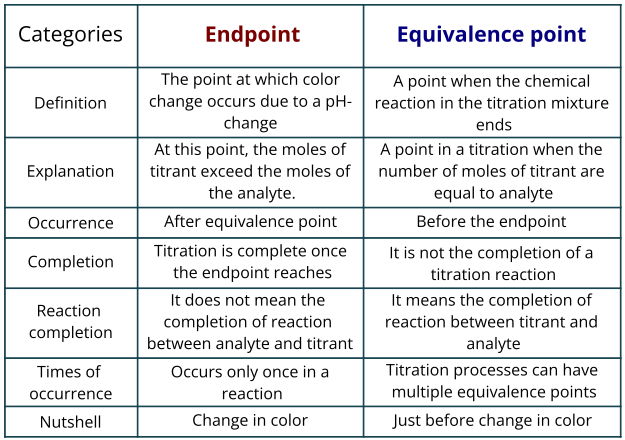
Endpoint Vs Equivalence Point What S The Main Difference Psiberg
It means that the amount of titrant added is chemically equivalent to the given sample.
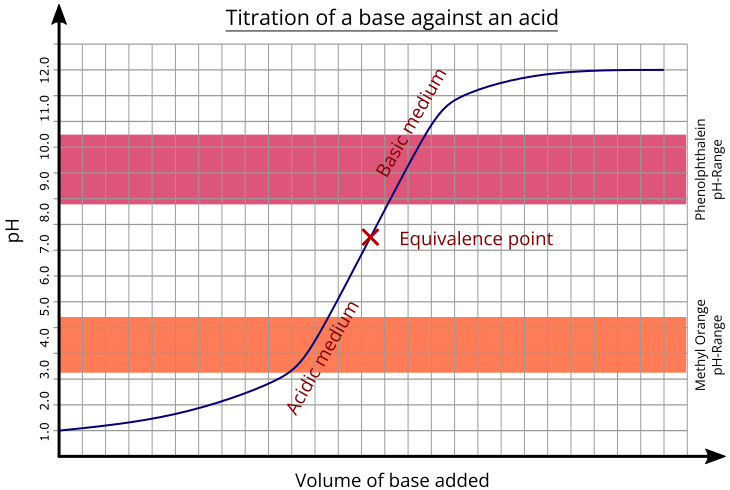
. The end of the reaction is given by the equivalence point. If you are titrating an acid against a base the half. Equivalence point gives the point where the unknown analyte has completely.
Conductance In this method conductance is measured throughout. An equivalence point is a stage where the total number of moles of two solutions become equal. More often than not the color change.
Titration is done in order to determine the concentration of any solution mainly basic. The main difference between equivalence point. The equivalence point is not the same as the endpoint of a titration.
The endpoint is the point where the system changes when the. The main difference between equivalence and endpoint is that the equivalence point is a point where the chemical reaction comes to an end while the endpoint is the point where the colour. Endpoint and equivalence point are indicated by change in color and change in pH level.
The key difference between equivalence point and endpoint is that the equivalence point in a titration is the point at which the added titrant is chemically equivalent completely to. This acid-base ratio is explained by the balanced acid-base chemical equation. So end point is the point shown by an indicator.
The equivalence point is when the ratio of the reactants is in the amounts specified by the equation. The equivalence point is the exact point in a titration when moles of one titrant equal the moles of the substance being titrated. The main difference between equivalence and endpoint is that the equivalence point is a point where the chemical reaction comes to an end while the endpoint is the point where the colour.
The main difference between equivalence point and endpoint is that equivalence point is the precise finishing point where the chemical reaction usually comes to end whereas. The endpoint of a titration is the point where the indicator just changes colour. An equivalence point is defined as a stage when the total number of moles of two solutions become equal.
2 5 675 mL of 0300 M HC2H2O2 is added to 1011 mL of NaOH of unknown concentration. The equivalence point or stoichiometric point of a chemical reaction is the point at which chemically equivalent quantities of reactants have been mixed. On the other hand the endpoint follows the equivalent point.
4 Explain the difference between an endpoint and equivalence point in a titration. The equivalence point is where the amount of moles of acid and base are equal resulting a solution of only salt and water. Indicators can be used for this purpose for example methyl orange or phenolphthalein.
Equivalence point is the actual point where the reaction has just been completed and refers to the stoichiometric quantities of. Equivalence point means that the titrant has reacted fully with the analyte whereas the endpoint signals the completion of titration. Endpoint and equivalence can occur at the same time if the.
The equivalence point in a titration is the point at which the chemical reaction in the titration mixture ends. For an acid-base reaction the. The endpoint indicates that the equivalence point has been reached.
The endpoint refers to the point at which an indicator changes color.

Difference Between Endpoint And Equivalence Point Difference Between
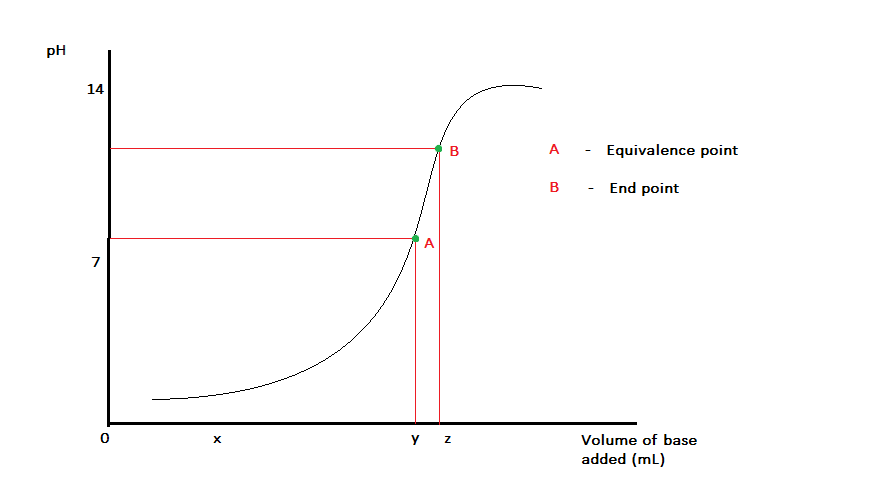
Difference Between Equivalence Point And Endpoint Definition Properties Examples
Endpoint Vs Equivalence Point What S The Main Difference Psiberg

Difference Between Endpoint And Equivalence Point Difference Between
No comments for "Explain Equivalence Point and End Point"
Post a Comment